| Compliance Status: Compliance |
| On-Site Reaffirmation Committee Report |
The institution provided extensive documentation related to the adequacy of capital resources, including master plans, regular assessment, and a plan focused on major and deferred maintenance. The provided Master Plan is aged (2013 adoption) but an update was initiated in April 2022. The Off-Site Reaffirmation Committee did not find a current approved capital budget in order to adequately evaluate current planned investment in facilities. The provided Facilities Condition Assessment indicated facilities in “fair” condition with a Facilities Condition Index (FCI) of 27%. The annual repair and renovation budget of $11m is less than 0.5% of the replacement value. In addition, the Off-Site Reaffirmation Committee was not able to find evidence of internal or external audit reviews of facilities, assessment of stakeholder satisfaction, or a description of ongoing preventive and regular maintenance of facilities nor of control and management of non-capital fixed assets (equipment). |
| Response |
After reviewing Auburn University’s submission for Standard 13.7, Physical Resources, the Off-Site Reaffirmation Committee had five questions or comments that required additional information and documentation. This response addresses each of those issues in turn, including (1) updates to the Comprehensive Campus Master Plan, (2) an approved Capital Budget, (3) the Facilities Condition Assessment, (4) external audits of facilities and stakeholder satisfaction, and (5) general management, oversight, and control of non-capital assets. Updates to the Comprehensive Campus Master PlanThe last Comprehensive Campus Master Plan (the Campus Master Plan) was completed and approved in 2013. University policy is to update the Campus Master Plan periodically, which we have interpreted to mean roughly every five years. However, the 2018 Campus Master Plan Update was delayed due to university leadership changes. Foundational Campus Planning Document DevelopmentSince 2013, our campus planning efforts have been strong and proactive. Numerous important campus planning documents have been developed over the last eight years to serve as key foundational elements for the university and as key components of our upcoming 2023 Campus Master Plan Update.
These include the following:
The guidance outlined in the Historic Preservation Element continues to play a role in our Capital Planning Process, as Auburn University values the impact of its historic buildings’ architecture and of its historic sites on the image and character of the campus. The university also strives to be inclusive by fostering a welcoming environment for all students, faculty, staff, and visitors. Historical recognition celebrates those people, facilities, and events that align with the university’s current values, while honestly and accurately reflecting upon historical events and persons. Historic Preservation guidance may be updated in future master planning efforts to assist the university in fulfilling its mission and meeting its goals.
The Board of Trustees adopted the Historic Preservation Element on February 7, 2014.
The Campus Landscape Element of the 2013 Campus Master Plan established a framework for the Landscape Master Plan by prescribing the overall organizational pattern of landscape types for the main campus. The more expansive, robust Landscape Master Plan is a 234-page document that includes detailed information on all aspects of landscape planning for the Auburn main campus, including the following:
The Landscape Master Plan reinforced the goals established in the 2013 Campus Master Plan, defined a Twenty-First Century Vision for the campus landscape, and established a set of tools to help guide the implementation of the vision. Provided as documentation is the Executive Summary of the robust, 234-page Landscape Master Plan document.
The Board of Trustees adopted the Landscape Master Plan on February 5, 2016.
Specific project sites identified in this update were based upon recommendations outlined in the Implementation section of the original 2013 Campus Master Plan Update.
The Board of Trustees adopted the Facility Development Update on February 5, 2016.
The College of Agriculture Master Plan did not require Board of Trustees approval.
The Parking and Transportation Study did not require Board of Trustees approval.
This second edition, adopted in 2021, focuses on the architectural Image and Character guidelines set out in chapter four of the first edition by providing direction on how future facility design can both connect to the university’s historic fabric and meet the needs of a growing and forward-looking university. It also provides guidance on how design is influenced by a project’s location on campus. It defines campus “sectors” by their functional purpose and how each sector impacts university development. The campus sectors developed as part of this plan will be a used in the 2023 Campus Master Plan Update analysis. Image and Character of Auburn University, Second Edition, makes these guidelines accessible to the various audiences, including the general public and design professionals. It ensures that all new projects undertaken by the university adhere to those qualities that make the university “Auburn” and maintains the role of the Planning, Design, & Construction team to establish and enforce procedures, guidelines, and standards for good design.
The Board of Trustees adopted the Image and Character of Auburn University, Second Edition 2021 on November 12, 2021. Campus Master Plan Update (2021-Present)Facilities Management initiated an update to the Campus Master Plan in early 2021, shortly after employees returned to campus following a COVID-mandated hiatus. This plan will represent a full revision of the Campus Master Plan, different in format than previous plans but fulfilling the same objectives to provide both a broad overview of the physical campus and a plan for updating the campus to meet the university’s strategic goals for the next 10 to 15 years.
Preliminary work by our campus planning team resulted in the mapping of and data collection for existing conditions on campus. To assist in advancing the plan, the university engaged SmithGroup as a consultant to leverage their technical expertise and experience planning campuses across the nation. Working as a team with the Facilities Management campus planners, SmithGroup visited campus twice during the fall of 2021 to gain a better understanding of campus and meet with the newly formed Master Plan Update Committee, which contained university-wide representation, and the senior leadership of large landowning units within the organization. University planners continued these meetings with the senior leadership of the remaining colleges during the winter and spring of 2022. Following these meetings, the university’s campus planners held nearly a dozen virtual co-creation workshops with their colleagues from SmithGroup. Over the summer of 2022, SmithGroup prepared an initial draft framework plan. Campus Planning and Space Management has recently completed its detailed review of the draft and provided comments to SmithGroup for action. A second draft is expected to be ready for review in the first quarter of 2023.
Whereas previous planning efforts employed traditional comprehensive master planning procedures, this effort uses a framework approach to maximize flexibility and keep pace with changing circumstances in the campus environment and pedagogical innovations. The framework approach views the campus through an interwoven set of components—land-use, circulation, and open space, among others—and seeks to organize the subsystems to meet overall development and design goals and objectives. By focusing on these components, the university avoids investing resources in detailed forecasting during the master planning phase. Instead, planning becomes an ongoing process, occurring continuously as new challenges are introduced to the university environment and decisions are made to address them. A framework plan maintains flexibility while providing meaningful guidance to future development decisions. The highest goal of the framework plan is to determine which areas of the campus must be preserved due to of their value to the campus environment, and which areas can be developed or improved to meet the future needs of the university. The following sections are currently under development and available as draft documents:
Capital BudgetCapital Project Budgeting Overview Auburn University does not have a specific budget line in its annual operating budget for capital projects. This line-item omission is largely due to the nature of how the university obtains funds for capital projects, as detailed in Section 2-B below. The capital project funding approval process is controlled by the Board of Trustees. All capital project budgets must be approved by the Board of Trustees. Once a decision has been made to fund a project, and it is approved by the Board of Trustees, the project execution process begins, and project expenditures are closely tracked and managed against the approved project budget.
To respond to the Off-Site Reaffirmation Committee’s question regarding capital budgeting, the following topics are detailed below: the policy that guides approval of capital projects, the sources of funding for capital projects, the management of that funding, and historic funding of capital projects.
Auburn University Board of Trustees (BOT) Capital Projects Approval Policy: Auburn University Policy D-3, “Capital Projects Approval Policy," provides important direction regarding the approval of capital projects.
These three requests for approval are formally presented to the Board of Trustees at one of their five annual meetings. Typically, these requests for project approval are made sequentially, over a period of months or years, although occasionally, BOT1 and BOT2 project approvals are requested simultaneously. In this manner, the university project budgets and funding are overseen and approved.
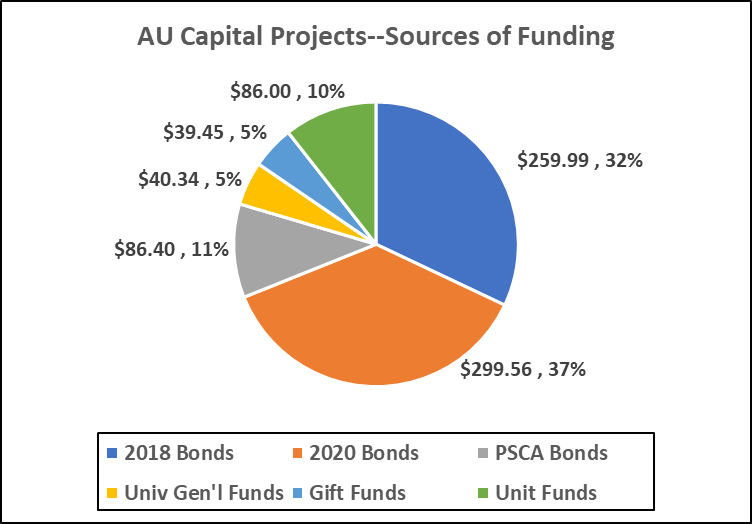
Sources of Funds for AU Capital Projects: The university does not typically receive funding from the State of Alabama for the construction of capital projects. However, the university has the authority to sell bonds to obtain funds for capital projects. The annual debt service on these bonds is paid by university revenues as part of the annual budget. Typically, the university will obtain bonds to fund numerous projects over several years. For example, the university obtained $256 million in bond funding in 2018 and $299.9 million in 2020.
University Capital Projects are often funded with other types of funds or multiple types of funding. Other sources of funds for capital projects include the following:
The diagram below details the relative percentages of the various types of funding sources for the current capital projects program.
Chart 13.7-1: Capital Projects Funding by Sources Type
See, for example, the funding plan for three upcoming capital projects for each using the various funds sources listed above.
Executive Facilities Committee Management of AU Capital Project Funding: The Executive Facilities Committee was established in 2020. The Executive Facilities Committee provides oversight over capital project funding and makes decisions regarding what projects should be recommended to the Board of Trustees for BOT1, BOT2, and BOT3 approvals. The Executive Facilities Committee tracks the following:
Facilities Condition Assessment and Annual Repair and Renovation BudgetFacilities Condition Assessment Program Overview The Facility Condition Assessment (FCA) Program accurately portrays the age of assets, helping develop plans for maintenance and repair, as well as identifying potential large-scale renovation or replacement projects. The objective of the program is to develop a Facility Condition Index (FCI) and a Current Replacement Value (CRV) for buildings and infrastructure, and to identify a total number of repair activities that are past due in each of the following categories: structure, roof, exterior, interior finishes, Heating Ventilation and Air Conditioning (HVAC), electrical systems, plumbing systems, conveyance systems, site, and infrastructure. The 2022 FCAP Annual Report includes a detailed description of the program; it is still being produced and is not scheduled for publication until February 2023. A detailed description of the program can be found in the 2021 FCAP Annual Report.
Repair and Renovation Budget Overview Rather than using the term "deferred maintenance," the university now conceives of this process as “repair and renovation" (R&R). Each year, the university includes funding for R&R in the budget process. These funds are used to cover large non-routine-cost repairs and required maintenance. Facilities Management meets quarterly to identify and rank projects that impact the university’s mission. The ranked projects that fall within the budget threshold are considered viable and worthy of execution within the fiscal year. Projects that fall outside the budget threshold are deferred until the importance increases, funding is made available, or a higher-ranked project is removed or deferred from the list.
To respond to the Off-Site Reaffirmation Committee question regarding the correlation between the FCA and the established R&R budget of $11 million, the following topics are detailed below: R&R’s percentage of the budget, unit and department funding of projects, and the overall assessment of the budget.
R&R as a Percentage of the Overall Facilities Budget: The annual Repair and Renovation (R&R) budget of $11 million represents 14.04% of the annual Facilities Management budget, and its intended purpose is to address system-level backlog and deferred maintenance issues in educational and general buildings across campus. Facilities Management’s FY22 budget, including the referenced repair and renovation allocation in the amount of $11 million, was $78.3 million, representing a budget valued at 3.2% of the replacement value of $2.47 billion. This contrasts with the 0.5% interpreted and cited by the Off-Site Committee. Clarification of this allocation can be seen in a detailed breakdown of the budget categories that make this $78.3 million (in Facilities Budget by Major Category).
Campus Client Funding of Projects: Campus units and departments have the ability to provide funding for upgrade, remodel, and renovation projects in spaces that are assigned to them.
In 2022, campus clients initiated 109 projects that were funded in part or in total by client-funded sources, totaling $3.14 million in funding, representing 37% of those project budgets. See Client Funded Projects 2022 for details.
In the past five years, campus clients initiated 563 projects that were funded in part or in total by client funded sources, totaling $114.3 million in funding, representing 30% of those project budgets. Client Funded Projects 2022 clarifies this five-year history as well.
Overall Assessment: Although additional funding for facilities maintenance and repair would always be helpful, the $78.3 million investment in maintaining and operating the university’s buildings, grounds, and infrastructure has been adequate to keep the quality of university facilities high. Audit Reviews of FacilitiesInternal and External Audit Review Overview Auburn University Facilities Management utilizes several methods to audit and benchmark process, procedures, funding, staffing, productivity, and outcomes. To respond to the Off-Site Reaffirmation Committee question regarding internal and external audit reviews, the following topics are detailed below: benchmark establishment; surveys of campus units; audits of space utilization, aging work orders, and custodial quality control; and collection and analysis of stakeholder feedback.
Gordian Benchmarking Consultant (External): Each year, Facilities Management works with the Gordian (formerly Sightlines) to complete a detailed campus space evaluation and benchmarking exercise. Gordian has a database of information from 450+ colleges and universities that uses for comparative benchmarking. This effort produces an annual report that provides quantitative data on capital investments and operational performance. It also provides long-term recommendations for future capital investment strategies and funding requirements based on current system conditions. The most recent reports from Gordian were received in July 2022. Provided as documentation are the Gordian Auburn FY21 Executive Summary and the FY21 Auburn E&G Facility Benchmarking Analysis Presentation.
Campus Planning and Space Management Space Survey (Internal): Each year, the Campus Planning and Space Management Office within Facilities Management works with representatives of each college and administrative unit to confirm the assignment (college/department/organization), location (building), status (occupied/not occupied), room type (FICM), general space use, and specific user allocation for all spaces controlled by the university. In addition, the Space Management team visits approximately 33% of campus spaces each year to verify the accuracy of its floorplans. The process yields a full review of every square foot of campus buildings every 3 years. (Engineering, the largest college space-occupier on campus, is fully covered over six years.)
Space Utilization Audits (Internal): The university performs regular audits of space utilization across the campus and for various space types to ensure that there is adequate space to meet the needs of university programming as well as to ensure that it is being utilized in an efficient manner. Examples of these audits are as follows:
Aging Work Order Audits (Internal): The Facilities Operations departments convene a weekly meeting to audit the oldest work orders that are still incomplete. As a rule, any work order that reaches 60 days in age from submission is reviewed and discussed weekly. Discussion includes current status, existing challenges, and future plan of action. Included as documentation is an example of the most recent list of work orders reviewed and discussed.
Custodial Quality Control Audits (Internal): In an effort to be proactive, Facilities Management has developed a robust custodial quality control program, with five inspectors who walk campus buildings on a randomized schedule and create deficiency reports for resolution. Each deficiency identified creates a work order action item for the custodial team to resolve. Each month, the reports are tabulated to give an overall view of how the custodial team is doing as compared to the Association of Physical Plant Administration (APPA) Level 2 expectations.
Stakeholder Satisfaction (Internal): Facilities Management utilizes multiple methods to maintaining an understanding of the level of satisfaction of campus clients.
At the completion of every work order submitted by a campus client, Facilities Management sends an email notification that indicates that the work is completed, and this notification also contains a survey link. The survey response rate, which averages all rates dating back to 2016 when this process was initiated, is 14.63% (13,431 surveys completed). These surveys reveal an overall customer satisfaction rate of 93%. Included as an illustration is a snapshot of the client survey metric dashboard.
In 2019, Facilities Management created the position of Assistant Vice President of Client Relations. This individual is tasked with regularly meeting and interacting with campus clients, particularly at the dean level. Regular meetings are held in which a key discussion point is the overall level of satisfaction with the services provided by Facilities Management, as well as opportunities for improvement. Any identified opportunities for improvement are then brought back for review by the senior leadership of Facilities Management so that ideas can be implemented effectively. Maintenance of FacilitiesOngoing Preventative and Regular Maintenance Overview Auburn University Facilities Management has a robust maintenance program with over 30,000 work orders annually. The program is primarily managed by two directorates: Maintenance and Utilities & Energy. Work order requests can be entered in three different ways: via an online portal, over the phone, and through email. A visual representation of the work order process is outlined in the provided documentation, which is an excerpt from the “Guide to Facilities Management” that is published on the Facilities Management website.
To respond to the Off-Site Reaffirmation Committee question regarding preventative and regular maintenance, the following topics are detailed below: Maintenance Department corrective work orders and preventative work orders, and Utilities & Energy Department preventative maintenance.
Maintenance Department Corrective Work Orders: When corrective maintenance work orders (meaning work orders for repair of something that has broken or failed) are entered for non-infrastructure campus properties, our Integrated Work Management System (IWMS) automatically assigns them to the Maintenance Department zone or shop that is responsible for the work. The Maintenance Department is organized into four zones that are broken down by client base, meaning that all of the buildings that are primarily occupied by a particular college fall within the same zone. A visual representation of the zone layout is shown in the Maintenance Zone Map.
Work orders for categories like roofing, electrical, heating and air, plumbing, carpentry, painting and many other trades are handled by the Maintenance Department. In the past 12 months, over 30,000 corrective maintenance work orders have been completed, with an average time to complete of 13.39 calendar days. The department’s stated goal is completion in under 14 calendar days.
Maintenance Department Preventative Work Orders: The Maintenance Department has a dedicated preventative maintenance (PM) staff of 27 HVACR technicians, electricians, and plumbers that work on the second shift and perform scheduled preventative tasks on a variety of campus assets. The PM program covers 7,612 unique assets across campus, including air handling units, exhaust fans, electrical panels, variable air volume (VAV) boxes, building generators, heat exchangers, air compressors, boilers, and many more. In the last 13 months, the PM crew has completed 130,530 of their 141,991 scheduled checkpoints, for a completion percentage of 91.9%. Attachment 5-4 Maintenance PM Completion Since 2011, the PM program has grown significantly, with the percentage of the allocated departmental budget expended rising from 6% in FY 2011 to 28% in FY 2022, which just ended. This growth is significant because it means the increased proactive nature of the Maintenance Department’s activities has prolonged equipment life and reliability, leading to a decrease in the need for corrective repairs.
Utilities & Energy Preventative Maintenance: The Utilities & Energy Department is responsible for caring for and operating the utility infrastructure of the campus. This includes high voltage electrical distribution, domestic water, sanitary sewer, chilled water, and hot water. To deliver highly reliable services, the Utilities & Energy Department has a comprehensive preventative maintenance program that covers 5,158 unique assets across campus, including switchgears, transformers, fire hydrants, water valves, backflow preventers, pumps, variable speed drives, and many more. In the last 13 months, the Utilities & Energy Department has completed 27,410 of their 28,809 scheduled checkpoints, for a completion percentage of 95.1%. Management, Oversight, & Control of Non-Capital Fixed AssetsProperty Services Property Services and Surplus Property are areas under Associate Vice President for Financial Services/Controller. The university utilizes the Banner Fixed Asset module, along with RFTrack (asset tracking software by inLogic), to perform inventories on all capital equipment over a two-year period (complying with the timing established by federal regulations). When assets are purchased, the next steps are followed by one dedicated auditor in Property Services who handles all such cases. The auditor reviews and analyzes the ePrint report FFPOEXT (Fixed Asset Orig[ination] Tag Extract), to identify equipment purchases greater than $5,000 (the university’s capitalization threshold). Next, the auditor identifies the applicable department contact name and number and then assembles appropriate documentation (purchase order or invoice) and documents the Fund Organization Account Program (FOAP) funding source,. The auditor serves as primary contact with the department to get the location of the asset and schedule a time to go and physically tag the equipment. Then the auditor takes pictures of each asset that is being tagged and verifies federal- and state-owned equipment under a grant by physically putting separate property tags on each asset, identifying it as “Federally Owned” or “Government Owned.”
The auditor then prepares correct and accurate documentation of asset cost for entry into Banner Fixed Asset module. Once documentation has been reviewed by other Property Services Auditors, this auditor scans in Adobe all additions, cost adjustments, and reversals and stores documentation in Xtender, and ensures that pictures are saved to OneDrive.
Similar procedures are followed to identify cost adjustments to equipment previously capitalized. If necessary, the same dedicated auditor prepares correct and accurate documentation of cost adjustments for entry into the Banner Fixed Asset module,. The other two auditors are responsible for performing the inventories. In addition, they review documented write-up of additions and use the Banner Fixed Asset module to make new additions to the system.
One of the auditors reconciles reports between Banner Finance system and the Fixed Asset system. The same auditor is responsible for the management of the Property Transfer system,,. This is a self-service Banner application that allows departments to indicate where they are moving equipment. The destination could be within their department, somewhere else on campus, or, if the item is no longer needed in an area, Surplus Property. When an asset is transferred to Surplus Property, other departments on campus are given an opportunity to purchase it from Surplus Property. Items are stored in a warehouse outside the core of campus. If departments do not want a given item, Surplus Property personnel inquire to see if any other state entity needs/wants the item. If the items are still available after that inquiry, they are placed up for auction on GovDeals.com,. Proceeds from the sales are split between Surplus Property and the department that originally purchased the item.
Information Technology Information Technology non-capital, fixed assets are managed and controlled via a variety of process and governance functions noted below. In addition, the Chief Information Officer (CIO) conducts an external Risk Assessment on a five-year basis. The previous assessment was done in 2017 by consulting firm Plante Moran. The CIO is currently negotiating a new Statement of Work (SOW) with a major, external consulting firm. The SOW outlines a comprehensive assessment of IT risk, focused primarily on central IT support but with a small sampling of risk to IT assets in distributed units. The Risk Assessment engagement will be overseen and managed by the CIO with the advice and engagement of the university’s Office of Audit, Compliance & Privacy. The final report, combined with the annual Penetration Test Report, will be provided to the IT Executive Council, the overarching IT governance body defined below. Finally, in accordance with Federal Trade Commission mandate, the CIO and Chief Information Security Officer provided an Auburn Board of Trustees working group a status update on Graham-Leach-Bliley Act cybersecurity compliance on 9 December, with a full written report scheduled for June 2023.
Control and management of non-capital fixed assets is accomplished via a number of existing processes. Those processes consist of an overall information technology governance process and coordination among the Office of Information Technology, the Biggio Center for the Enhancement of Teaching and Learning, the Chief Financial Officer (CFO), and the Central Unit Allocations Committee on investment and maintenance of computing labs, classroom refreshment, research computing, and improvements to student engagement. Management and control of the university’s primary software system, Banner, is overseen by the Banner Oversight Committee.
Information Technology Governance: The CIO and CFO co-chair the executive-level IT governance process. That process was initiated by the CIO in 2018. The primer sent to all council members is included as evidence. The update to the projects controlled and overseen by the council is also included as evidence. IT Executive Level governance is currently in a refreshment cycle. New members have been engaged, and an updated charter is in draft and will be approved in Q1CY23 when the new council meets. The following documents provide further evidence:
Computing Labs & Classroom Refreshment: Funding for classrooms and computer labs is controlled and managed on both a capital project and recurring maintenance basis. The 2021 Project Recap document provided contains a list of capital projects approved through the Auburn Budget Process and overseen by the CIO and CFO.
Documentation supporting the management and control of classroom assets is as follows:
Research Computing: Research computing is overseen jointly by the Office of the Vice President for Research and Economic Development and the CIO. Investment is determined by representatives from colleges and schools through a governance committee (see below), but all faculty who invest are welcome to participate. The OIT Director for Infrastructure provides updates and communication to the University Research Council in support of the University Research Council. Monthly reports on HPC utilization are used to manage and control the asset allocation, maintenance, and investment. Supporting documents related to non-capital fixed asset management are as follows:
Capital Assets Supporting Student Experience: Non-capital assets include software, file servers, and virtual reality headsets.
Enterprise Resource Management: The University deployed Ellucian Banner Human Resources, Financials, and Student Information System in support of daily operations. This system represents a substantial investment in non-capital fixed assets when considering the software, hardware, and ancillary systems. Overseeing this investment is the Banner Oversight Committee. Documentation is as follows:
ConclusionThe overall physical facilities of Auburn University are adequate in quality, scope, and condition to support the university’s mission. The university ensures that it has the assets to support the institution’s needs through efficient and effective maintenance, fiscally constrained capital improvements, and near- and long-term planning of the campus’ built environment. The institution regularly evaluates the appropriateness and sufficiency of physical resources, including classrooms, libraries, and laboratories. All facilities are properly and routinely maintained, and Facilities Maintenance provides multiple avenues for all campus constituencies to report issues and request service. Through comprehensive risk management practices, the institution ensures that campus assets are adequately protected and insured. Finally, the institution invests in building, maintaining, and protecting technological infrastructure sufficient for the needs of all students, faculty, and staff. |